
FIBHGM promotes a new university collaboration to develop innovative projects that extend their impact to the hospital environment
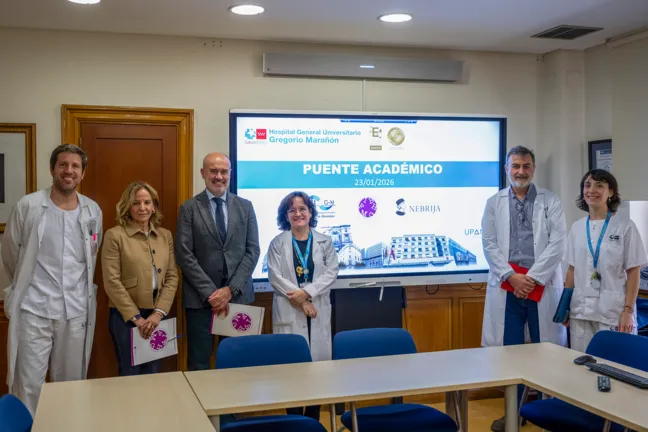
An educational cooperation agreement has been signed with Nebrija University
La Fundación para la Investigación Biomédica del Hospital Gregorio Marañón (FIBHGM) has signed an educational cooperation agreement with Universidad Nebrija that will enable the development of a model of applied innovation and talent development in the healthcare environment through training programmes.
Students will be able to work alongside professionals, enabling them to acquire practical skills in translational research and technology transfer. The projects undertaken will address specific hospital needs, with clear objectives and measurable outcomes to promote experiential learning.
Through this initiative, the Madrid healthcare centre continues to strengthen its innovation ecosystem and its commitment to generating knowledge, attracting talent and developing solutions that help improve patient care.
The agreement will enable students from various undergraduate and postgraduate programmes to undertake curricular and extracurricular placements, as well as complete undergraduate and master's dissertations, becoming integrated into translational research, innovation and transfer projects carried out at the hospital.
Furthermore, the various services and departments of Marañón will be able to propose challenges that will be transformed into guided projects for students, with clear objectives and tangible results.
These projects may be developed using agile working methodologies, such as innovation sprints, collaborative activities or hackathons, in which students and hospital professionals will work together to generate solutions, prototypes or proposals applicable to the healthcare environment.
Teaching, research and applied innovation
Rubén Pérez-Mañanes, an oncological surgeon and scientific deputy director of the Instituto de Investigación Sanitaria Gregorio Marañón, highlights that the agreement "consolidates a multi-academic ecosystem at the hospital and opens up a practical pathway for developing talent in translational research and innovation: learning by doing, with mixed teams, well-defined challenges and specific projects that connect the university and the hospital environment".
The programme is open both to students from healthcare disciplines, including biomedical engineering, and to profiles from other areas of the humanities, who can contribute key skills to drive innovation in an increasingly technological and multidisciplinary hospital environment.
In addition to generating short-term solutions, these experiences may become pilots, proof-of-concept studies or new lines of applied research within the hospital.
For Teresa Fernández, managing director of the Fundación para la Investigación Biomédica del Hospital Gregorio Marañón, the agreement "strengthens the integration of teaching, research and innovation at our hospital, enabling students to apply their knowledge in a real-world environment and contribute to the development of new solutions that improve hospital activity and healthcare research".
The agreement will also help promote projects with greater competitive capacity in regional, national or European funding calls by combining the university's academic capabilities with the hospital's clinical, research and technological expertise.