

Animal Experimentation Ethics Committee (CEEA)
CEEA/OH
The Animal Experimentation Ethics Committee (CEEA) is the body responsible for the ethical and scientific evaluation of projects, experimental procedures and teaching activities involving the use of laboratory animals at HGUGM/IiSGM. Its work is governed by the legislation in force on the protection of animals used for scientific and teaching purposes, in particular Royal Decree 53/2013 and the applicable European legislation, as well as the corresponding regional provisions.
The Committee carries out its work independently, ensuring that any activity requiring the use of animals is duly justified from an ethical, scientific or educational standpoint, is conducted in accordance with proportionality criteria and respects the principles of replacement, reduction and refinement (the three Rs). It also safeguards animal welfare, the scientific quality of studies and compliance with the applicable legal and ethical framework.
CEEA Mission
The Committee’s mission is to rigorously, objectively and transparently evaluate projects involving the use of animals, ensuring that they are carried out only when no scientifically valid alternatives exist and that procedures are designed and performed in the most humane manner possible.
The Committee aims to promote responsible research compatible with the protection of animal welfare, compliance with current legislation and the assurance of the scientific quality of the results obtained.
CEEA Values
Independence: Act with technical autonomy when issuing reports and conducting evaluations, avoiding conflicts of interest and ensuring impartiality in decision-making.
Scientific rigour:
Base evaluations on sound scientific evidence, robust methodological criteria and quality standards that guarantee the validity and reproducibility of results.
Regulatory compliance:
Ensure strict compliance with the legal framework in force at national and European level, including legislation on animal protection, research ethics and applicable regulatory requirements
Animal welfare: Consider animal welfare an essential principle, promoting practices that minimise pain, suffering and stress.
Confidentiality and information protection: Ensure the confidentiality of all documentation assessed by the Committee, including projects, personal data and sensitive scientific information, limiting its use exclusively to the authorised evaluation purposes.
Transparency: Provide clear, up-to-date and accessible information on the Committee’s role, its procedures and its institutional framework.
Social responsibility: Recognise the existing social sensitivity regarding animal experimentation and act with prudence, proportionality and respect towards the public.
Continuous improvement: Encourage the ongoing updating of knowledge, the adoption of alternative methods and the periodic review of procedures and evaluation criteria.
Legal framework and authorisation procedure
The legislation in force requires that, before the start of any research project involving the use of animals, it must have the express authorisation of the competent authority of the corresponding Autonomous Community.
To obtain this authorisation, it is essential to have favourable reports from the Animal Experimentation Ethics Committee Animal Welfare Body (OEBA) of the centre and from an Approved Body (OH) for project evaluation, as well as to ensure that the personnel involved have the training and accreditation required by the legislation in force, including the provisions of Royal Decree 53/2013 and Order ECC/566/2015.
Principles and commitments
- Application of the three Rs: Actively promote the principles of replacement, reduction and refinement.
- Animal welfare: Understand animal welfare as an end in itself and as a scientific requirement.
- Environmental enrichment: Promote measures that improve the quality of life of animals in facilities.
- Training and accreditation: Promote the ongoing training of the personnel involved.
Composition
The Committee is made up of a multidisciplinary team comprising biologists, veterinarians, doctors, nurses and other professional profiles related to biomedical research and animal welfare. All its members have specific training and official accreditation for the evaluation of animal experimentation procedures in accordance with ethical, scientific and legal standards.
The Committee also includes:
- An animal welfare adviser from the centre,
- Researchers not directly involved in the procedures being evaluated.
- Professionals accredited for animal handling and project design.
- An independent person with experience and knowledge in animal welfare who has no direct relationship with the centre or with the procedures being evaluated.
The Committee’s composition ensures disciplinary plurality, technical expertise and independence in evaluation.
Types and functions of the different bodies involved
- CEEA-OEBA: Responsible for the ethical evaluation and monitoring of animal experimentation projects carried out at IISGM/HGUGM.
Its functions are:
· Evaluate projects and procedures involving the use of laboratory animals.
· Issue the mandatory ethical reports for the administrative authorisation of projects.
· Ensure compliance with good scientific and teaching practices.
· Promote the application of alternative methods and the reduction of the number of animals used.
· Ensure respect for animal welfare and the environment.
· Guide and advise researchers on compliance with regulatory, technical and ethical requirements.
· Monitor authorised projects and evaluate incidents related to animal welfare, proposing corrective measures when necessary
· Foster a culture of care, responsibility and scientific integrity in matters of animal welfare within the institution
For further information, please consult Article 38 of Royal Decree 53/2013.
- CEEA-Approved Body (OH): Responsible for the regulatory evaluation of projects and the issuance of mandatory ethical reports in accordance with Royal Decree 53/2013.
The Animal Experimentation Ethics Committee has been designated as an OH by the competent body of the Community of Madrid since 9 October 2013.
The OH will evaluate projects submitted by personnel affiliated with the Gregorio Marañón Health Research Institute (IiSGM) that are carried out both at this centre and at other authorised centres.
This designation allows it to issue the ethical reports required by Royal Decree 53/2013 as a prerequisite for authorising projects involving the use of animals for scientific purposes.
The evaluation carried out by the CEEA-OH aims to assess:
- The scientific, educational or regulatory justification for the project,
- The need to use animals and the impossibility of achieving the objectives through suitable alternative methods. Analyse the balance between the possible harm or adverse effects caused to the animals and the expected scientific, educational or social benefits.
- The application of the principles of replacement, reduction and refinement.
- The conduct of procedures in the most humane and respectful manner, ensuring animal welfare and minimising their impact on the environment.
For further information, please consult Articles 39 and 43 of Royal Decree 53/2013.
CEEA-Approved Body (OH) Regulations (In Spanish)
- Community of Madrid: Responsible for the final administrative authorisation of projects (PROEX)
MONITORING COMMITTEE
The CEEA has a Monitoring Committee made up of committee members, the animal welfare officer, animal facility personnel, the IiSGM quality manager and representatives of FIBHGM who are members of the CEEA.
The purpose of this committee is to monitor authorised projects, promoting animal welfare, regulatory compliance and the continuous improvement of procedures.
CONTACT
1. Institutional Statement on the Use of Experimental Animals
The Gregorio Marañón Hospital Health Research Institute (IiSGM) has signed the transparency agreement on animal experimentation (In Spanish), promoted by the Confederation of Scientific Societies of Spain (COSCE), with the collaboration of the European Animal Research Association (EARA), and launched on 20 September 2016.
We are aware that animal research plays a fundamental role in understanding the biological mechanisms involved in diseases and in the development of medical treatments. Without the use of animals, we would not have most of the medicines, antibiotics, vaccines and surgical techniques used in human and veterinary medicine.
Part of the scientific work carried out at the IiSGM that contributes to improving people's lives relies on the use of animals, for example, in studies to improve the efficiency of organ transplants, new cancer treatments, methods for hepatic regeneration in patients or paediatric resuscitation techniques, etc.
The welfare of experimental animals is a fundamental issue for the IiSGM, as is strict respect for and compliance with the legislation in force on the protection of animals used in experimentation and for other scientific purposes, including teaching. Our objective is to achieve the highest standards of animal welfare, not only out of moral responsibility towards the animals, but also because high-quality science cannot be achieved without animal welfare. Our animal experimentation complies with legal standards and is reviewed by an animal experimentation ethics committee, which promotes the use of alternative methods, the reduction of the number of animals used and the refinement of experimental procedures. No research project requiring the use of animals may begin without the required ethical assessment and final authorisation from the relevant competent authority.
The IiSGM also ensures that both personnel caring for the animals and researchers involved in experimentation have the necessary training and knowledge, and undertakes to provide the resources required for the proper maintenance of experimental animals with regard to facilities, upkeep, welfare and veterinary care.
2. Guide for Researchers
Introduction
Every procedure involving experimental animals carried out at the Gregorio Marañón General University Hospital (HGUGM) / Gregorio Marañón Health Research Institute (IiSGM) requires prior ethical assessment and administrative authorisation, in accordance with Royal Decree 53/2013 and the legislation in force.
This section provides a general summary of the process for assessing and authorising animal experimentation projects.
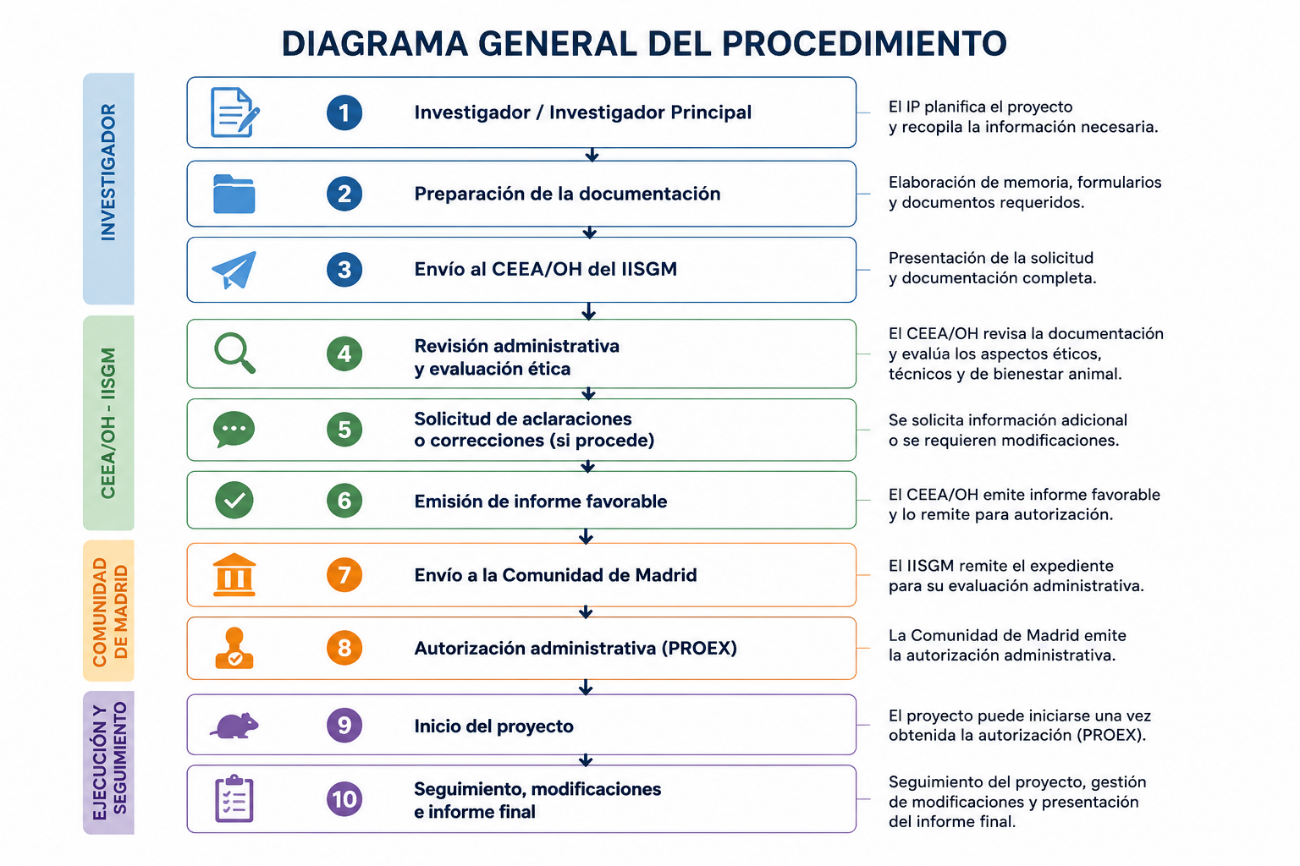
GENERAL PROCEDURE
General assessment and authorisation flow
TYPES OF APPLICATION
1. Provisional certificate for competitive calls
Document intended for funding applications and competitive calls requiring a preliminary ethical assessment of the project.
2. New project to request authorisation from the Community of Madrid
Application for ethical assessment and administrative authorisation for a new animal experimentation procedure or project.
- Substantial modification
A substantial modification is any modification affecting animal welfare and involving a change in the severity of procedures (new procedures or modifications to those already authorised), an increase in the number of animals exceeding 25% of the number initially authorised, a change of species, a change in the project objectives, a modification of aspects affecting the 3Rs, or a modification of the circumstances requiring authorisation for an exception to the provisions of Royal Decree 53/2013, as well as any combination of these and even the accumulation of non-substantial modifications where this is deemed appropriate.
- Non-substantial modification
Changes that do not significantly alter the scientific objectives, the severity of the procedures, animal welfare or other essential aspects of the authorised project. Three modifications per project are accepted.
A non-substantial modification is any modification that, although it may not directly affect animal welfare, is not included in the above category.
- Renewal
Application to continue projects whose current authorisation is nearing its expiry date.
- Final report
Project closure document once the authorised procedures have been completed.
- Monitoring
Supervision and monitoring procedures carried out by the CEEA/OH to check the progress of authorised projects, ensure animal welfare and ensure proper compliance with the legislation in force.
DOCUMENTATION AND FORMS
The documentation required for each procedure is available in the “Documentation and forms” section.
It is always recommended that the most recent versions of the documents available on the website be used.
CALENDAR AND DEADLINES
The annual meeting calendar, application submission deadlines and indicative assessment times are available in the “Calendar and deadlines” section.
IMPORTANT INFORMATION
The favourable report issued by the CEEA/OH does NOT authorise the start of the project without the corresponding administrative authorisation issued by the Community of Madrid.
No procedure involving animals may begin before the corresponding valid administrative authorisation has been obtained.
FREQUENTLY ASKED QUESTIONS
The most common queries relating to project assessment, modifications, authorisations and administrative procedures can be consulted in the “Frequently asked questions (FAQ)” section.
3. How to Submit an Application
Applications relating to animal experimentation projects must be sent to the CEEA of the Gregorio Marañón General University Hospital / Gregorio Marañón Health Research Institute (IISGM), accompanied by the relevant documentation according to the type of procedure.
IMPORTANT INFORMATION
No procedure involving animals may begin before the corresponding administrative authorisation issued by the Community of Madrid has been obtained (RD 53/2013). Incomplete applications or missing mandatory documentation may delay the assessment process.
TYPES OF APPLICATION
- Application for a provisional certificate for competitive calls
In certain competitive calls (for example, projects of the Carlos III Health Institute or other public or private calls), a document certifying the preliminary ethical assessment of the project may be required.
The CEEA may issue provisional certificates for funding applications and competitive calls.
1.1 Important information
The issue of this certificate:
- does not constitute final authorisation of the project,
- does not replace the full ethical assessment once the project is assessed independently of funding and does not replace the required administrative authorisation,
- and does not allow procedures involving animals to begin.
1.2 Required documentation
|
Document |
Mandatory |
|
Project summary |
Yes |
|
Available scientific report |
Yes |
|
Preliminary estimate of the number of animals and procedures |
Recommended |
|
Call information |
Yes |
1.3 Recommendations for the scientific report
To facilitate a favourable provisional assessment, it is recommended that the scientific report explicitly include:
- the budget allocated to experimental animals and associated procedures,
- the authorised and certified facilities where the procedures will be carried out,
- the justification and calculation of the sample size,
- and certification of the participating personnel for the corresponding functions (b, c and at least one researcher with function d).
It is also recommended that the report expressly refer to compliance with:
- the principles of replacement, reduction and refinement (3Rs),
- Directive 2010/63/EU, Royal Decree 53/2013 and Ministerial Order ECC/566/2015,
- and the ARRIVE guidelines for animal research (link).
It is also recommended that the refinement measures planned to reduce experimental variability and minimise the number of animals used be described.
In projects developed at the Foundation for Biomedical Research of the Gregorio Marañón Hospital (FIBHGM), it may be stated that the centre has official authorisation from the Community of Madrid for animal experimentation.
Example paragraph:
“The use of animals in this project is necessary for xxxxx. Conducting animal trials is mandatory before initiating a clinical trial. However, our planning complies with the three Rs (Replacement/Reduction/Refinement) principle, in accordance with EU Directive 2010/63/EU and Spanish legislation (Royal Decree 53/2013 and Ministerial Order ECC/566/2015). In addition, all studies will be designed, conducted and reported in accordance with the ARRIVE (Animal Research: Reporting of in Vivo Experiments) guidelines. The experiments will be carried out at nationally certified institutes for laboratory animal science, solely under the highest standardisation criteria and with extensive experience. FIBGHM is a centre authorised for animal experimentation by the Community of Madrid, with code number E5280790000087. With regard to model refinement, we will apply xxxxx, which will allow us to reduce variability and therefore reduce the sample size.”
“The use of animals in this project is necessary to xxxxx Conduction of animal trials is mandatory before initiating a clinical trial. Nevertheless, our planning conforms to the three R's (Replacement/Reduction/Refinement) principle, in accordance with the EU Directive 2010/63/EU and Spanish law (Real Decreto 53/2013 and Orden Ministerial ECC/566/2015). Further, all studies will be designed, executed and reported in line with the ARRIVE (Animal Research: Reporting of in Vivo Experiments) guidelines. Experiments will be carried out at nationally certified institutes for laboratory animal science only under highest standardization criteria and long-standing expertise. FIBGHM is an authorized center for animal experimentation of the Comunidad de Madrid, with Code Number E5280790000087. Regarding model refinement, we will apply xxxxx which will allow us to reduce variability and thus reduce sample size.”
- Application for assessment of a new project to be submitted to the Community of Madrid
Every procedure involving experimental animals requires prior ethical assessment and administrative authorisation in accordance with the legislation in force.
2.1 Required documentation
|
Document |
Mandatory |
|
Application form |
Yes |
|
Project report ANNEX X |
Yes |
|
Non-technical summary (NTS) |
Yes |
|
Accreditation of participating personnel |
Yes |
|
Supplementary documentation |
Depending on the project |
Instructions for completing the project report ANNEX X (In Spanish)
Instructions for completing the NTS (non-technical summary):
Non-technical summary. The model in Excel format approved by the European Union and provided to the authorised bodies must be used. It must use language understandable to the general public and be anonymous with regard to the participating institutions or individuals (terms that could identify the funding entity of the specific project must not be included).
Regarding the content
- “NTS” tab: boxes 54 and 55 relating to the project start and end dates must be completed.
- “Expected harms” tab: the estimated number of animals in the report must be entered.
- The animals must be entered in the box corresponding to the maximum severity they will experience, with “non-recovery” being the lowest severity and “severe” the highest severity. All columns with values equal to or greater than “0” must be completed. Animals must not be duplicated (e.g. an animal cannot be scored under both “mild” and “non-recovery”).
- “Fate of animals kept alive” tab: if no animals are to be listed on this tab, it must be left completely blank (including “0”). The species and zeroes must be deleted.
- Assessment
Following the initial review, the committee may:
- Request clarifications or modifications,
- Issue recommendations,
- Issue a favourable report.
- Issue an unfavourable report
- Application for a Modification
Any project change that could have a negative impact on animal welfare will entail a new assessment by the CEEA-OH and, where appropriate, a new authorisation from the competent body, in accordance with Article 32.6 of RD 53/2013.
Modifications will be classified as follows:
- Substantial modification:
A substantial modification is any modification affecting animal welfare and involving a change in the severity of procedures (new procedures or modifications to those already authorised), an increase in the number of animals exceeding 25% of the number initially authorised, a change of species, a change in the project objectives, a modification of aspects affecting the 3Rs, or a modification of the circumstances requiring authorisation for an exception to the provisions of Royal Decree 53/2013, as well as any combination of these and even the accumulation of non-substantial modifications where this is deemed appropriate. They will require a new assessment by the CEEA-OH and new authorisation from the competent body. Indicative examples include: a change of animal species, a significant increase in the number of animals, the introduction of new invasive procedures, an increase in severity and significant changes to the scientific objectives.
Non-substantial modification:
A non-substantial modification is any modification that, although it may not directly affect animal welfare, is not included in the above category. They will be notified to the CEEA-OH for assessment and, if favourable, the principal investigator or the CEEA-OH will notify the competent authority.
Indicative examples include: adding accredited personnel, minor timetable changes, administrative adjustments and replacement of equivalent equipment.
The principal investigator responsible must notify the CEEA-OH of any modification before it is implemented.
Required documentation
|
Document |
Mandatory |
|
CEEA project modification form with a description and justification of the changes. |
Yes |
|
Version of the CEEA report with the changes marked |
Yes |
|
Version of the non-technical summary (NTS) with the changes marked, where applicable |
Yes |
|
Supplementary documentation |
Recommended |
3.2 Important information
The final classification of the modification will be determined by the CEEA/OH after reviewing the application. Certain modifications may require an update or new administrative authorisation from the Community of Madrid.
- Application for Renewal
Authorised projects must request renewal whenever it is necessary to continue activities included in the project beyond the current authorised period.
4.1 Required documentation
|
Document |
Mandatory |
|
Renewal application |
Yes |
|
Progress report or project summary |
Yes |
|
Justification of the need for renewal |
Yes |
|
Updated information on procedures and animals |
Depending on the case |
Important information
It is recommended that the renewal procedure be started sufficiently in advance of the expiry date of the current authorisation.
4. How to Apply for Administrative Authorisation (PROEX) from the Community of Madrid
Once the favourable report from the CEEA/OH has been received, the responsible investigator must apply for administrative authorisation of the project from the Community of Madrid.
The prerequisites are:
- Having a valid digital certificate,
- Being registered in the Community of Madrid’s electronic notifications system.
Community of Madrid website for applying for authorisation (PROEX):
The application may be generated by CEEA members at the request of the responsible investigator.
.1 Required documentation
|
Document |
Mandatory |
|
Project proposal |
Yes |
|
Favourable CEEA report |
Yes |
|
Project report |
Yes |
|
Non-technical summary (NTS) |
Depending on the project |
|
Certificates accrediting the functions (a, b, c, d) of all persons involved in the project. |
Recommended |
|
Timetable included in the project report justifying the duration in months of the procedures. |
Recommended |
Authorisation obtained
Once authorisation has been obtained from the competent authority of the Community of Madrid, the decision must be sent to the CEEA of the IiSGM.
Final report
Once the procedures of the authorised project have been completed, the corresponding final report must be submitted in accordance with the procedures established by the CEEA/OH.
5. Calendar and Deadlines
ANNUAL CALENDAR
The annual calendar of CEEA/OH meetings of the IISGM will be updated periodically on this page.
Calendar (In Spanish)
APPLICATION SUBMISSION DEADLINES
Complete applications received before the established deadline will be assessed at the committee’s next ordinary meeting.
Incomplete documentation or documentation submitted after the deadline may be assessed at the next available call.
INDICATIVE ASSESSMENT TIMES
The assessment time will depend on:
- the complexity of the project,
- the type of application submitted,
- the documentation provided,
- and the need for additional clarifications or modifications.
Applications requiring supplementary documentation may have their assessment process temporarily suspended until the requested information is received.
URGENT APPLICATIONS
Urgent applications will be assessed on an exceptional basis and must be properly justified.
Acceptance of urgent processing will be subject to the committee’s assessment and the operational availability of the CEEA/OH.
DEADLINES RELATING TO ADMINISTRATIVE AUTHORISATION (PROEX)
Administrative authorisation of the project is the responsibility of the Community of Madrid and is processed independently of the CEEA/OH assessment.
Once the complete documentation has been submitted, the Community of Madrid establishes a maximum decision period of forty working days, without prejudice to any possible suspensions of the procedure provided for in the legislation in force.
IMPORTANT INFORMATION
It is recommended that applications be submitted sufficiently in advance, particularly for projects associated with competitive calls, renewals or complex procedures.
The issue of a favourable report by the CEEA/OH does not authorise the start of the project without the corresponding administrative authorisation issued by the Community of Madrid.
6. Project Monitoring
The Animal Experimentation Ethics Committee (CEEA) is responsible, among other functions, for monitoring authorised research projects.
The purpose of monitoring is to safeguard animal welfare, ensure compliance with the principles of replacement, reduction and refinement (3Rs), and support researchers in the responsible management of their projects.
Monitoring will be carried out proportionately to the characteristics, complexity and severity level of the authorised procedures.
PURPOSE OF MONITORING
The purpose of monitoring is to promote responsible, transparent research aligned with animal welfare and scientific quality standards, encouraging the continuous improvement of procedures and proper compliance with the legislation in force.
HOW IS MONITORING CARRIED OUT?
The CEEA has a Monitoring Committee made up of committee members, the person responsible for animal welfare, animal facility personnel, the IISGM quality manager and representatives of FIBHGM.
The monitoring procedure consists of three main phases:
1. Contact with the researcher
The researcher responsible is informed about the monitoring procedure, and information is collected through interviews, forms or other communication mechanisms.
2. Visit to the animal facility
The following are reviewed:
- housing conditions,
- the health and welfare of the animals,
- the procedures carried out,
- and compliance with the authorised conditions.
3. Document review
The person responsible for animal welfare reviews the documentation associated with the project and cross-checks the authorised information (PROEX) against the records available at the animal facility.
REPORTS AND OUTCOMES
All information obtained during monitoring will be entered into the CEEA’s recording system, including visits, interviews, incidents and actions carried out.
Following the relevant review, the CEEA will issue a monitoring report, which may be:
- Favourable (without significant incidents).
- Favourable with recommendations or minor adjustments.
- Favourable with a request to modify the project.
- Unfavourable, where serious deficiencies or significant breaches requiring additional action are identified.
Where appropriate, the committee may notify the relevant institutional authorities of the incidents detected.
Documents
Introduction
This section contains the forms and documents required for the submission, assessment, monitoring and closure of animal experimentation projects managed by the CEEA/OH of Hospital General Universitario Gregorio Marañón / Instituto de Investigación Sanitaria Gregorio Marañón (IISGM).
It is recommended that you always use the most recent versions of the documents (In Spanish) available on this page.
IMPORTANT INFORMATION
The use of obsolete forms may require the documentation submitted to be updated and resubmitted.
GENERAL REGULATIONS AND DOCUMENTATION
Main regulations (In Spanish)
- Directive 2010/63/EU https://www.boe.es/doue/2010/276/L00033-00079.pdf
- Royal Decree 53/2013 https://www.boe.es/diario_boe/txt.php?id=BOE-A-2013-1337
- Ministerial Order ECC/566/2015 https://www.boe.es/diario_boe/txt.php?id=BOE-A-2015-3564
Recommended guidelines and resources
- ARRIVE Guidelines: https://arriveguidelines.org/
- PREPARE Guidelines: https://norecopa.no/PREPARE
- NC3Rs: https://nc3rs.org.uk/
- FELASA: https://felasa.eu/
- EURL ECVAM: https://tsar.jrc.ec.europa.eu/